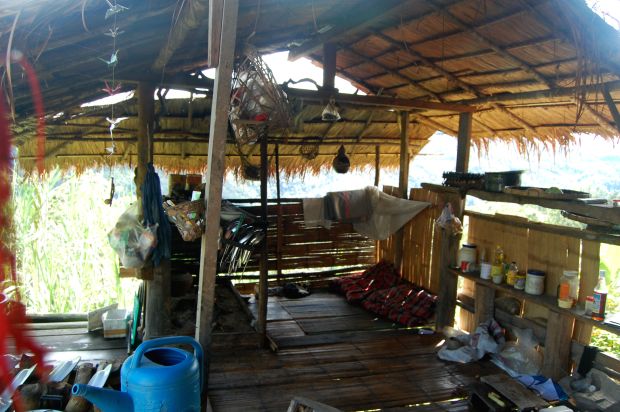
“Omeliah,” Papa said to us as we strolled up to the rice paddy kitchen, a leaf-covered bamboo pavilion that holds all the essential cooking supplies, a fire pit, and even a reserve of blankets and pillows for midday rests. These are the trademark home-away-from-homes for the Karen people, erected at any rice paddy a family owns – an arrival at which marks an end to one’s typical hike from town to work site.
Translated literally, ‘omeliah’ means ‘have you eaten rice?’ Translated loosely, the phrase becomes a more general ‘have you eaten anything?’ It is one of those common cultural nuances that makes sense among the many hill tribes of northern Thailand, wherein rice is the staple of sustenance. Among the Karen, this is also as close as I could get to discerning any type of greeting. From what I could tell, their live’s are all so fluently entwined that there is simply no use for the word hello.
Which makes sense when day to day living surrounds meeting the most basic of human needs. Their survival depends on a togetherness that ascends any call for keeping tabs. They help each other wherever necessary, without qualms over one-sidedness or worry of not receiving anything in return. A few villagers may lend a couple days to another family’s rice fields, if those fields are ready and it is their time to be cut. They will share a day’s bounty if the bounty is big, because the next they may find it to be overly sparse. What they kill they divide among family and neighbors; they have no refrigerators to keep their slaughtered meats fresh. Thus it seems that a community founded on giving is synonymous with their survival. And so arises a phrase like ‘omeliah,’ in a culture where food is at the center of nearly every endeavor.
Arriving at the kitchen is an excuse for the first of many rests for the day. The hikes from town to rice field – the family I stayed with owned at least three on which I worked – are typically long and strenuous, through jungle paths that weave along steep hillsides like trails of condensation on a sweating glass. It is usually around 9:30 by the time you arrive, and the sun has long been out in full force. So on the bamboo floor of the raised pavilion, you rest, with a book or with your eyes closed, and wait for the signal to start working a short time later.
It was my first day in the fields and like any beginner, I was too inexperienced to know better than to wait in eager excitement at getting my rice hands dirty. Because the rice in this particular field had already been cut and bundled, our job for the day would be to collect these bundles off the hills – arm fulls at a time – to bring back so that the rice could be beaten off it’s stock. It seems inevitable that monotonous labor lies at the root of one’s work when one lives for pure survival.
And so we worked the morning away, climbing down the face of the centrally located hill on which a tarp was placed for delivering our loads, and slowly expanding outwards. Once the rice of the first hill was collected, we moved on to the next, in as orderly a fashion as possible while trying not to lose our footing along the hill’s steep face, rice bundles nestled carefully on our shoulders as we made our way down and then back up to the tarp that seemed to grow further and more daunting with each trip. From a distance, I finally heard our host yell. “Ok! Lunch ready!”
Some days, this would consist of a stew containing pumpkin or other vegetables freshly collected off the nearby land. They tend to grow a lot on the land surrounding the rice paddies, as there is much less space around their homes in town. Other days, it might be whatever was leftover from dinner the night before. Once, we were treated to chicken, slaughtered tableside moments after being carefully selected from the coop beside the paddy kitchen. On this day, it would be soup with a fire-crisped mouse, taken that morning from a trap that had snared it’s fate sometime the night before. In any event, you could always count on one thing for sure: white rice would be the base of any meal to come your way, and it would almost always be accompanied by the spicy nuances of a freshly pounded chili paste.
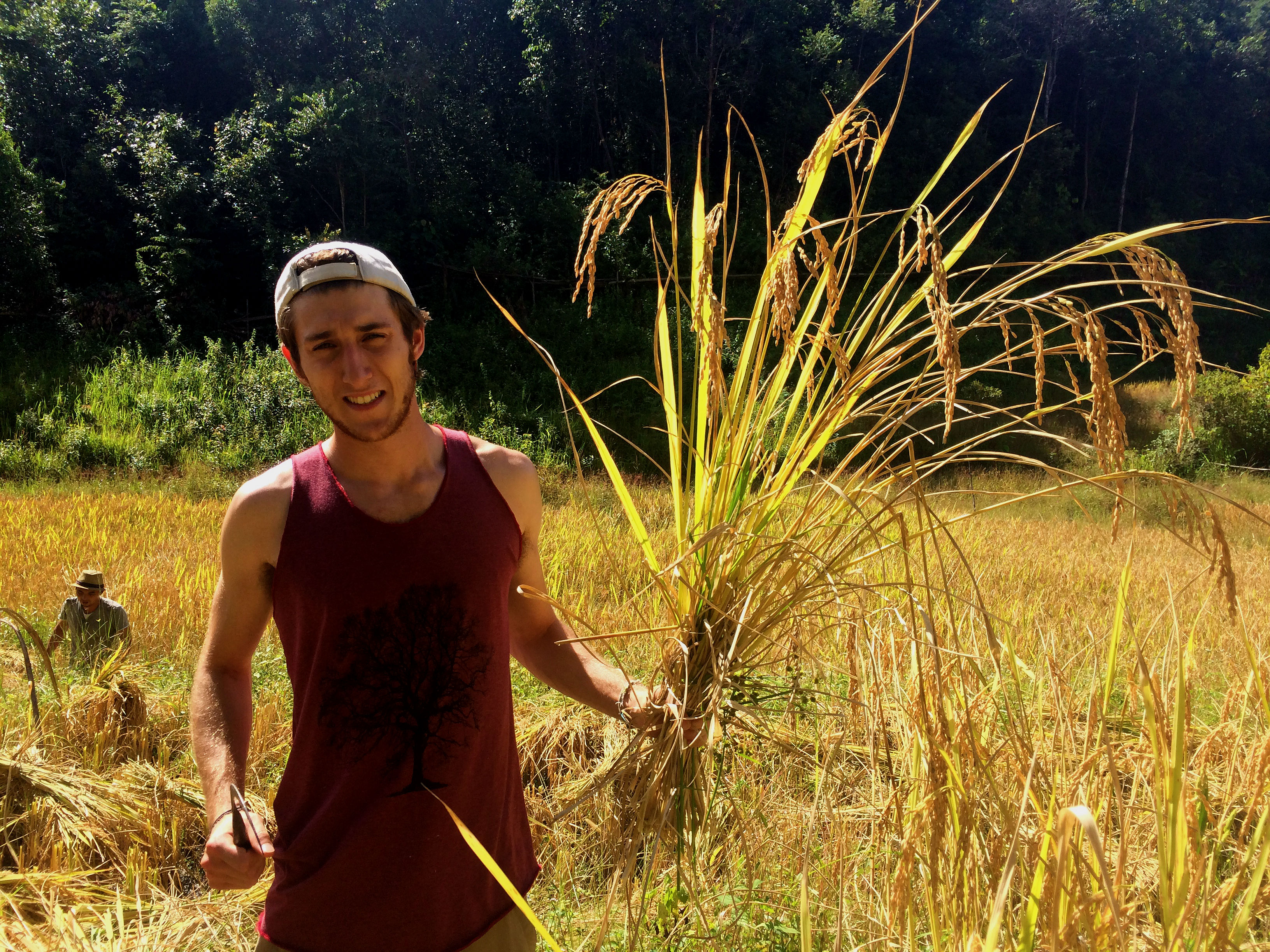
In this way I learned what it meant to live a day as a Karen farmer. After three days, all the rice on the field had finally been gathered. When we weren’t venturing out to get bundles, we were pounding rice stalks against a raised wooden platform with two narrow panels of wood (they almost looked like oversized chopstix, with the ends connected by rope to wrap the base of the stalks with) as a method of separating the rice for bagging. Rice cultivation is laborious, and I was happy to find out that at our next paddy we would be cutting and tying the bundles instead.
Some of the paddies still had water in them while we cut, sometimes as deep as your knees, and with this always brought an increased vigilance for water spiders and leeches (the latter of which I proudly picked off several). The work was never easy, but whenever it seemed that fatigue was starting to set in, John – the husband in the pair that owned the farm – would call us to the kitchen for a meal or for a rest. It was a lazy schedule that allowed plenty of time to read or nap in between sessions out in the field, and lunch was always a learning experience.
If one were to ask what my biggest takeaway from living with the Karen people was, I suppose I wouldn’t be able to say. It could be the impressiveness of the sheer labor put into each days search for food, and the generations of passed on knowledge that goes behind it. Or maybe it is the genuine ease of mind that seems to come with a life lived for daily survival. They were a peaceful kind of happy, much more so than you would expect from a people who work so tirelessly just to eat. I guess it’s not so simple to pull something so quantitative from such a qualitative experience. Like any, it’s a culture that can’t easily be summed up.
One thing did seem clear: when it comes to the Karen people, all they have is today. Once they eat, it’s time to move on to preparing for the next meal. Stockpiling isn’t really an option without the power for refrigeration. Whenever I heard talk about the future, it was brief and out of necessity. And once that was settled it was straight back to the task at hand. It might be more accurate to say that worry doesn’t become a large part of one’s experience if he only has the means to focus on the little he can do at one time.
There is no multitasking in manual labor. You work on something, complete it, and move on to the next. That is not to say there is no planning; it is typical for Karen men to begin amassing timber for their future homes as young as 18. But when you build everything by hand, the options are sparse and the task is enormous. I wonder if it is this lack of option that affords such ease of mind?
No, these aren’t things that will make sense right away. Maybe they’ll seep in with casual reflection, over time and without any consummate understanding. After all, who am I to claim any such understanding when I was only an impostor, a Karen villager for just two weeks? And even then, the future always seemed to find a way of making itself present inside my head.
All I can say with confidence is that for an unadorned newcomer like me, the living was tiring and the work formidable. Still, when it is all you know, I suppose it’s just regular life. Business as usual. And when you replace the innumerous stressors with a limited number of lofty do-or-dies, the little things just aren’t worth the value of your time. Gives a shiny new allure to that whole ‘less is more’ thing, wouldn’t you say?




 mindfuljester.com
Thank you so much for writing this. I love reading your experiences.
LikeLike
Thank you for the support! Glad you enjoyed the words
LikeLike
You are very welcome and I look forward to reading more!
LikeLike
Amazing. Thank you for your well written words. Sounds like you are gaining and abundance of wisdom on your travels.
LikeLike